Mosquito Management Program
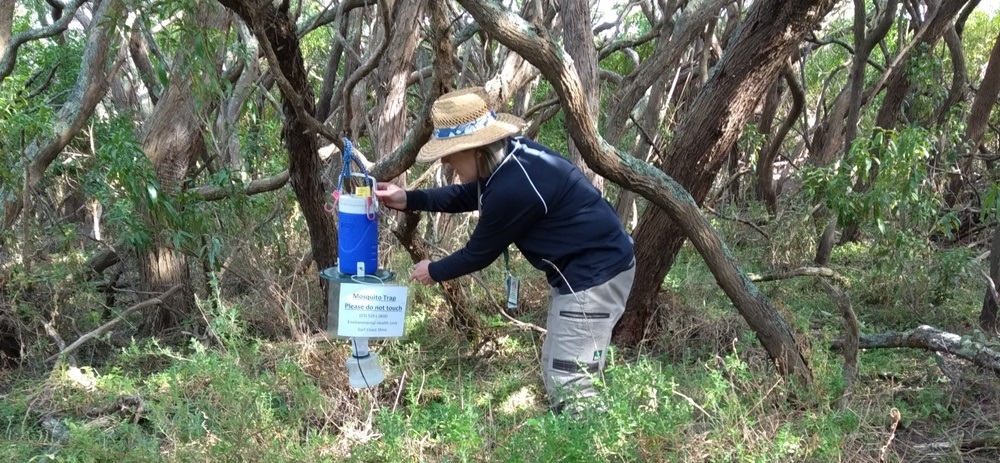
Council's Mosquito Management Program runs annually over the peak mosquito season, from October to April. The program aims to reduce the incidence of mosquito-borne disease and lower the number of biting mosquitoes within the community.
The program includes the following activities:
- Monitoring major breeding sites for mosquito larvae.
- Trapping mosquitoes for laboratory analysis.
- Undertaking ground and aerial treatments.
- Educating the community.
- Responding to public enquiries.
Please note that individual land owners are responsible for the management and treatment of mosquitoes on private property.
Trapping mosquitoes for laboratory analysis
As part of the State Government’s Victorian Arbovirus Disease Control Program (VADCP), Council receives funding to undertake adult mosquito surveillance.
This involves trapping mosquitoes at designated monitoring locations across the Shire which are then sent to the Agriculture Victoria Research (AVR) laboratory for analysis. The laboratory helps with species identification, counting mosquitoes collected, and testing for the following mosquito-borne viruses (Ross River, Barmah Forest, Murray Valley encephalitis, Japanese encephalitis, and West Nile - Kunjin strain).
Testing results may then be used to:
- Issue public health alerts when there is an increased risk of mosquito-borne disease.
- Identify priority areas for mosquito treatment activities.
Council data is also entered into the VADCP Mosquito and Mosquito-Borne Disease Surveillance Report, which monitors mosquito-borne disease risk across Victoria.
For further information, please refer to the video below.
Ground and aerial treatment of public water bodies
When mosquito larvae are detected in public water bodies, Council may undertake treatment using approved larvicides to reduce mosquito numbers and the risk of mosquito-borne disease.
Most treatments are conducted by Council officers on the ground. However, in some cases, Council engages the City of Greater Geelong (COGG) to undertake aerial treatments using drones in areas that are otherwise difficult to access.
COGG holds the necessary permits and approvals to undertake aerial treatments safely and in a manner that protects the environment, animals, and the community. Property owners located in close proximity to treatment areas are also notified prior to any aerial treatment activities taking place.
For further information about aerial mosquito treatments, visit the City of Greater Geelong website.
Mosquito treatment products used
When Council undertakes ground treatments, or when the City of Greater Geelong is engaged to undertake aerial treatments, mosquito larvicides are used.
These products used are specifically designed to target mosquito larvae and have minimal impact on non-target organisms. As a result, their impact on people, animals, and the broader environment is considered negligible.
Products are approved for use by the Australian Pesticides and Veterinary Medicines Authority (APVMA) and include the following:
| Product Name |
Active Ingredient |
APVMA Registration |
Treatment Type |
| Vectobac G Biological Larvicide Granules |
Bacillus thuringiensis subsp. Israelensis strain AM65-52 (Bti) |
Product No. 52834 |
Ground and aerial |
| Prolink Pellets Mosquito Growth Regulator |
(S)-Methoprene |
Product No. 58064 |
Ground and aerial |
| Prolink XR Briquets Mosquito Growth Regulator |
(S)-Methoprene |
Product No. 58061 |
Ground |
What you can do
There are some simple steps you can take to help protect yourself from mosquito bites at home or when heading out and about, including:
- Maintain insect screens on windows, doors, vents and chimneys.
- Remove any stagnant water around your property to prevent mosquitoes from breeding.
- Change the water in pet bowls, bird baths and vases weekly.
- Check and maintain rainwater tanks and other water storage containers to ensure screens are intact and mosquitoes cannot enter.
- Use insect surface spray inside and around the home to help kill mosquitoes.
- Apply an effective mosquito repellent containing either picaridin or diethyltoluamide (DEET) to exposed skin.
- Wear loose-fitting, light-coloured clothing to help reduce mosquito bites.
For further information, visit the Better Health Channel website.
Make an enquiry
If you have any questions about the program, or are aware of a problematic water body that may require treatment, please contact Council’s Mosquito Management Officer by completing an online request form.