Hop off the grass: trial to support ecosystem recovery

Eastern grey kangaroos are among the Surf Coast’s most recognisable forms of wildlife.
They’re an iconic feature of our coastal and rural areas, regularly spotted in Anglesea, Aireys Inlet, Moriac, Winchelsea and other parts of the shire.
While they’re an important part of our natural environment, kangaroos in high numbers can also create challenges.
As part of its role looking after Council-managed nature reserves, our Environment team has started a trial of kangaroo exclusion fencing in the Painkalac Valley.
Council’s Environment Coordinator Jessica Miller said an increased kangaroo population can put significant pressure on native vegetation.
“Over-grazing has a serious impact, and the roos can also flatten vegetation in areas where they regularly rest and shelter,” Jessica said.
“The goal of the fencing trial is to see if limiting kangaroo and wallaby access to a small section will help protect and regenerate this sensitive area.
“The roos can still move around the fenced area, so can easily access grazing and resting areas up and down the valley corridor.”
The kangaroo-proof fencing being used for the trial takes in an area of around 25 square metres, and is made from strong and high chain mesh fencing.
The recommendation for a trial came from a State of the Environment report by expert ecologists, including a botanist and mammal specialist, who determined that the hundreds-strong kangaroo population was likely reducing the amount of native grass and herb cover in the valley next to the creek.
“By reducing grazing in the fenced area, the trial will give us insight into how quickly vegetation recovers when kangaroos and wallabies can’t access it,” Jessica said.
“This will give us valuable information to help us support more biodiverse and resilient ecosystems and identify ways to protect vulnerable vegetation into the future.”
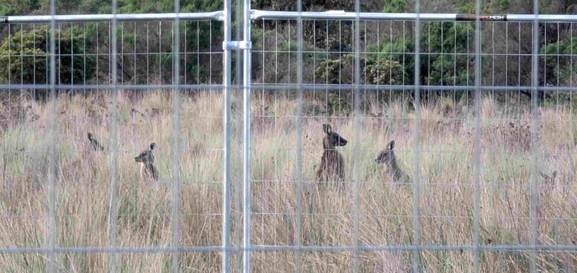
The fencing trial is one of several management tools being used by Council’s Environment team to help restore balance and improve the resilience of native landscapes.
The fencing will remain in place for at least a year, with monitoring of herb and grass species undertaken alongside Council’s regular weed management programs (both inside and outside the fenced area).
If the trial is successful, Council will continue to implement exclusion fencing in other locations in the valley to give grasses and herbs a chance to recover.